

February 20, 2026
Australian organisations face a major challenge: a lack of talent in the finance sector. It’s expected that the shortfall of finance talent will reach about 64,000 by 2030.
And the effects of this shortage are far-reaching. This talent vacuum creates a strategic bottleneck, stalling critical decision-making and, ultimately, stifling top-line growth.
This shortage is only aggravating the problems for finance teams that are now considered a key partner in decision-making, not just a team that reports past performance.
As a CFO, you need to look for the right talent that can help you plug skill gaps in your team and drive decision-making.
The solution?
Smarter hiring strategies. Let’s look at them.
The Shift from Traditional Accounting to Strategic Finance
In the past, the finance team was a backward-looking function, with a focus on compliance and historical reporting. That role has now shifted to a strategic, forward-looking partner that drives business growth.
Today, however, market volatility demands far greater agility.
Finance teams now need to use advanced analytics and tools like Power BI and Tableau for predictive forecasting and real-time insight. This enables them to influence future growth, manage risk, and adapt quickly.
The finance professional’s role is now centred on translating complex financial data into actionable, strategic insights for decision-making.
And for that, finance professionals need more than technical knowledge.
They must have commercial acumen and the ability to influence and even challenge executive decisions. In fact, about 50% of organisations now consider business partnering as the top skill when hiring FP&As.
In a nutshell, you need to fill gaps in your finance teams and hire employees who don’t just report financial performance but also communicate what needs to be done for future growth.
They should be adept at understanding financial data, identifying trends, and deriving insights from it, becoming strategic advisors who use data to inform business decisions.
The Rising Demand for Data, Systems, and Analytical Capability
Because finance professionals are increasingly expected to guide executive strategy, they must be adept at working with big data and high-level analysis.
Additionally, financial services firms are quickly bringing artificial intelligence into the mix as well. About 61% of these firms are using or assessing generative AI globally.
There’s also a growing need for professionals who can use tools like ERP systems, data visualisation platforms, and automation tools. These tools play a crucial role in enabling finance professionals to make better sense of data quickly.
While ERPs provide the ‘source of truth,’ visualisation tools translate that data into a narrative, and automation strips away the manual drudgery that leads to burnout.
This is where things become challenging for businesses. Finding candidates who can combine both finance expertise and technical capability is difficult.
In fact, most organisations (48%) report that hard/technical skills specific to a job role have a gap in their teams. Data literacy, gen AI, and tech-savviness are among the other top missing skills.
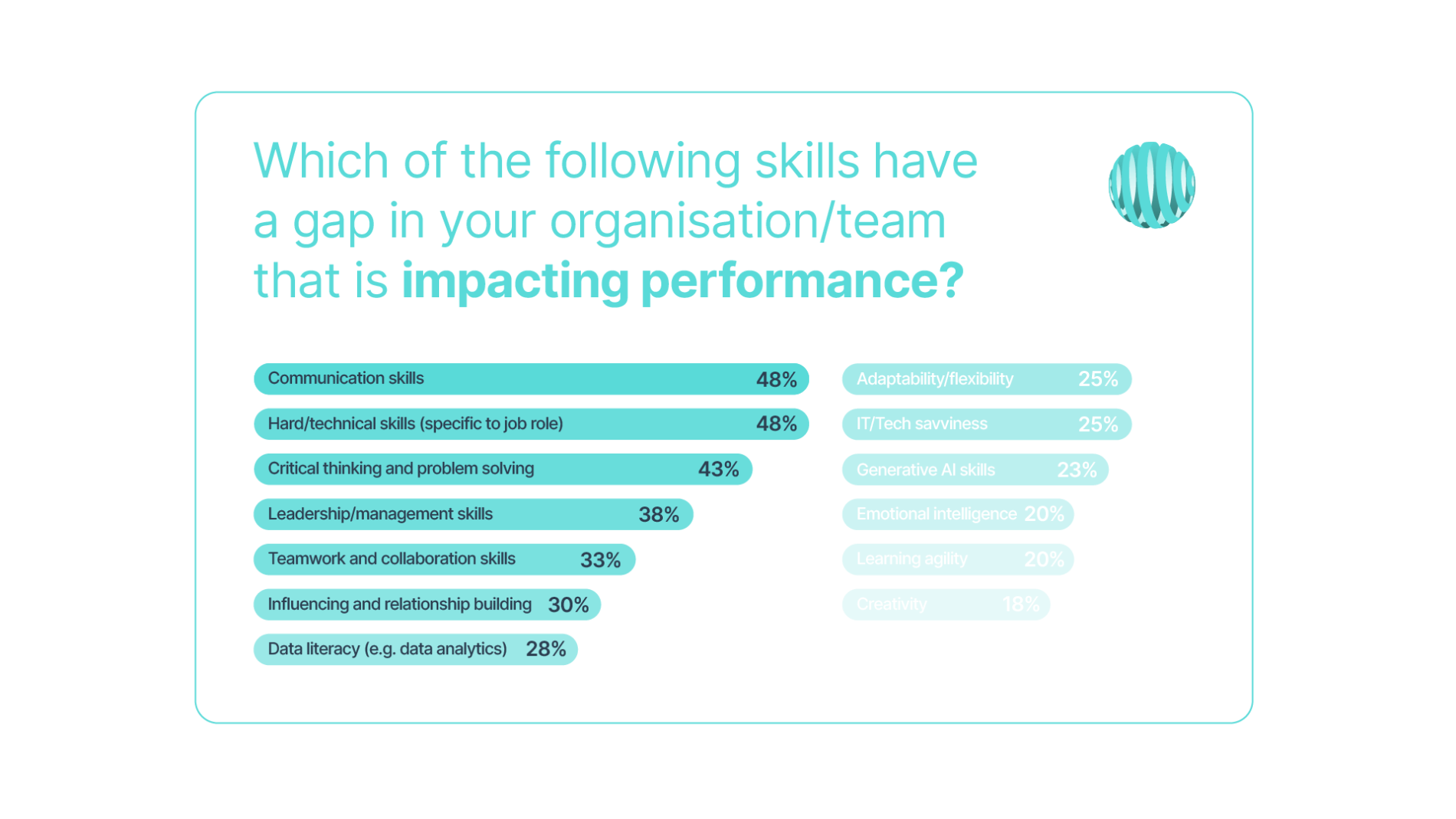
As a CFO, it’s imperative to find employees who possess these skills to fill those critical gaps that may be holding back your business growth.
Leadership Gaps Within Finance Teams
As mentioned in the image above, leadership and management skills are a key gap among financial organisations, with 38% of businesses lacking them.
Organisations are struggling to hire experienced candidates who can guide finance teams through change.
Leadership skills also play a key role in stakeholder engagement. Finance teams need to convey their insights clearly to the management to get their buy-in. It requires strong communication skills and solid business thinking.
Professionals who possess these skills ease into leadership roles and contribute positively to the organisation by guiding key decisions and playing a crucial role in succession. It’s all about ensuring business continuity and enabling a smooth transition.
Competition for High-Performing Finance Talent
Owing to the massive talent shortage in the market, there’s a huge supply/demand gap. In a landscape where candidates hold the leverage, they’ll likely opt for the best and most predictable opportunity.
Here’s what could cost you the right candidates:
- Slow hiring process: If your hiring process is slow and requires multiple follow-ups from the candidate, they might end up looking elsewhere. You must be transparent and try to wrap up the process as quickly as possible.
- Unclear job positioning: Your job descriptions must be clearly written. They must communicate what’s expected from the candidate. The same should reflect in your interviews. High-performing candidates will choose roles they want.
- Poor candidate experience: Your recruitment process is your brand’s first handshake; inconsistent communication or a ‘black hole’ feedback loop will send top-tier talent straight to your competitors.
Beyond these factors, competitive compensation and meaningful flexibility remain essential to making a role attractive.
How Businesses Can Close the Finance Skills Gap
Job descriptions can only get you so far. They often focus on a static list of duties, whereas moving to a skills-based hiring approach is a much better option to close the finance skills gap.
This strategy focuses on identifying exact skills missing from your team and hiring candidates who possess them. The core philosophy here is to evaluate the potential impact a candidate can create, rather than just the boxes they can tick.
You can identify a few core measurable outcomes and start looking for candidates based on them. This helps you project the tangible value a new hire will bring to your organisation and enables you to measure success from day one.
Conducting skills-based evaluations makes things far more straightforward. Instead of just relying on a candidate’s past experience, these assessments verify their actual capability to perform in the role.
It also helps identify other transferable and “nice-to-have” skills to determine if the candidate is the right fit.
Start Filling Gaps in Your Finance Team
The finance team serves as a strategic partner for business growth, and that’s why it’s essential to fill the skills gap in this department. They can make all the difference in setting your business on the path to sustained growth and resilience.
And with the right recruitment partners, that task becomes slightly easier in a market with talent scarcity.
At TalentWeb, we help you manage the entire recruitment process and give you access to passive talent that would otherwise be difficult to find. We specialise in hiring candidates in the finance sector, helping you build future-ready teams that bring both technical and financial skills together.
Connect with our team of experts now to discuss your requirements.
Latest News and Insights